

What I Will and Won’t Carry. International Women’s Day post
Today is International Women’s Day. I’m writing this on the nineteenth day of fasting during Ramadan—a fast I began the night I saw the new
Two years ago, I made a pro-con list to decide whether to stay in the UK or return to Italy.
On the left: what I’d gain. On the right: what I’d lose.
I listed everything. Higher salary in the UK. Proximity to my sisters and parents there. Cheap hairdresser. Green city. Community events—Riverside festival, Caribbean carnival, jazz all year round. The freedom of living somewhere people could actually understand my past. The relief of not being the only Black woman in the room, again and again.
On the Italy side: my young nieces (I had maybe three to five years before they became teenagers who wouldn’t want to hang out with their aunt anymore). Better food. Mountains in winter, sea in summer. Affordable housing. The fantasy that maybe, just maybe, I could finally feel at home.
At the bottom of the UK column, I wrote: “Freedom from the eyes of people that hurt me in Italy.”
At the bottom of the Italy column: “Fear of Italians hating me for what I wrote.”
I put the list aside for weeks. Then I revised it. I colour-coded it in the hope that logic could solve what was, in fact, a question of survival.
In the end, I chose Italy.
Not because the pros outweighed the cons. Not because I’d forgiven this country or suddenly felt Italian. Not because I thought things would be different.
I came back by process of elimination. And because I was ready—reluctantly, warily—to give Italy a second chance.
There’s not much difference between the UK and Italy when it comes to government policies or what either country expects from immigrants. Both are hostile in their own ways. Both have bureaucracies designed to exhaust you. Both have populations who benefit from your invisibility.
I considered Nigeria. But I don’t feel equipped to move there. That’s the reality I’m still learning to sit with—the fact that I can feel displaced in Italy, alienated in the UK, and also not ready to set my life in the place that birthed me because safety isn’t just about who looks like you. Sometimes it’s about not having to explain yourself at all. And the proximity to people who think they know you, who might envy what you’ve built elsewhere, can be a matter of life and death.
So here I am. Back in the country I once called “too hostile and with too little prospect” for my future children. The country I told other immigrants to avoid. The country that made me feel like a fish out of water every single day.
Why?
Because my nieces are still young. Because I want to know my brother’s wife better. Because there are two friends here I love, even if they have their own families now. Because the food is undeniably better, even if I’ve stopped eating most dairy, meat, and bread. Because the mountains are still here, and the sea, and the particular quality of light in spring (like in these days) that I haven’t found anywhere else.
And because I’m curious.
Curious to see if Italy has changed. Curious to see if I have changed enough to live here differently.
Curious what happens when you return to a place that wounded you—not to be healed by it, but to see if you can finally exist in it without shrinking.
On Thursday, March 26th, I went to a football match for the first time in my life.
Italy vs. Northern Ireland. World Cup qualifiers. Played in Bergamo, of all places. I’m not a football fan. I didn’t even know about the match until the day of, but when I found out, I bought a ticket immediately. It felt uncommon—rare, even—to have a match of that caliber played here.
My seat was in Curva Nord. The ultras section. I ended up sitting between some quiet fans, thankfully. But there were a couple of foul moments. When Italy scored, some fans raised their fists in fascist salutes while chanting the player’s name. The alarm in me went off. My body tensed. I kept my face neutral.
Overall, it was fun. I liked being there alone. Liked the scale of it—the big stadium, the noise, the collective energy. I even grabbed one of the free blue Italy scarves given out during the break.
But I’m not going to lie: I walked as fast as I could back to my car when the match ended.
That’s what it’s like to be back in Italy. Moments of genuine enjoyment punctuated by the reminder that I’m never fully safe. That I have to stay vigilant. That even in a crowd of people cheering for the same team, I am not one of them in the way that matters.
And yet. I stayed for the whole match. I didn’t leave early. I held the scarf.
I’m still figuring out what that means.
Five years ago, the award-winning Pan-African linguist Djeneba Deby Bagayoko wrote the preface to the first version of my memoir. She wrote:
“This morally intact diary shows the complexities, doubts, defeats, multitudes, rarities, joys, and beauties of being who you don’t yet know you are.”
I read that line dozens of times and didn’t understand it.
Being who you don’t yet know you are.
What does that even mean? How can you be something you don’t know?
Now, I think I’m starting to get it.
Deby also wrote:
“Finding balance, coexisting with parts of yourself, and living with others while minimising contradictions—family, friends, nations, institutions that demand we display certain parts of ourselves at the expense of others equally important and fundamental to our identities—is a complex game whose rules are improvised. For years you pass levels and go back, searching for new strategies to understand who you are, when, and with whom.”
Not choosing one identity over another. Not code-switching to survive. Not performing integration or belonging or gratitude.
Just… existing. In all my contradictions. Without apologising for them.
I am West African, Italian, and Muslim. I fast during Ramadan sometimes. I smoke shisha sometimes. I have sex. I write about trauma. I love my family and keep them at a distance. I voted for the first time as an Italian citizen and felt nothing. I grabbed an Italy scarf at a football match and clutched my keys walking back to my car.
I contain multitudes. And I don’t owe anyone a coherent narrative that makes them comfortable.
You don’t come back the same person who left. And the place isn’t the same either—or maybe it is, and that’s the point. Even if you sense that the place has changed a bit, maybe you’re the variable that matters.
I used to think confidence could protect me. That if I was smart enough, polished enough, successful enough, I’d be safe from the scrutiny. From the racism. From the question behind every interaction: Do you belong here?
However, confidence is threatening to people who benefit from your doubt. Especially to white women who see you as competition they never agreed to enter. Especially in a country that still doesn’t know what to do with Black women who refuse to shrink.
I used to think I needed validation. I wanted someone to tell me I was beautiful, not shame me for existing in my body. I wanted consolation, not judgment.
Now I’m asking a different question:
Who would I be if I didn’t have to live a life wrapped around responding to someone else’s demons?
What would I do if I stopped performing worthiness? If I stopped anticipating reactions? If I let myself be as loose, as careless, as contradictory as my Italian colleagues—or better yet, as the men who never have to calculate the cost of their honesty?
I don’t have the answer yet. But I’m here to find out.
The bureaucracy is still a Kafkaesque nightmare. The politics are still harmful. The microaggressions are still daily. But I notice I’m carrying it differently now. Some exhaustion has lifted—not because the environment changed, but because I have.
I care less about whether Italians accept me. I care less about whether publishing houses think my story is marketable. I care less about proving I deserve to be here.
I didn’t come back because I forgave this country. I came back because I’m done waiting for permission to exist on my own terms.
I came back because my nieces are young and I want to know them while they still want to be known.
I came back because at some point, you have to stop running from the places that hurt you and start asking: What am I still giving this place power over?
What I can’t control: other people’s perception of me. Their fear of my confidence. Their discomfort with my complexity.
What I can control: my honesty. My boundaries. My decision to publish this memoir myself, in my own voice, without dilution.
Italy didn’t save me. People didn’t save me. The citizenship didn’t save me. But maybe that was never the point.
The point is learning to save myself. Wherever I am.
Deby was right. I am still becoming who I don’t yet know I am.
And that’s not a failure. It’s the work.
Improvising the rules as I go. Passing levels and going back. Searching for strategies to understand who I am, when, and with whom.
I don’t have to choose one country, one identity, one version of myself and commit to it forever.
I can be here, in Italy, and still carry the UK with me. I can fast. I can smoke. I can grab the scarf and walk quickly to my car. I can love my family and protect myself from them. I can vote and feel ambivalent. I can write about this country’s cruelty and still choose to live in it—for now.
That’s what it means to be who you don’t yet know you are.
Giving yourself permission to change. To contradict yourself. To come back to places you swore you’d never return to, not because you were wrong to leave, but because you’re different now and you want to see what happens.
So here I am. Back in Italy. Still angry. Still wary. Still carrying trauma in my body.
But also: curious. Hopeful, in a guarded way. Ready to see if I can build a life here that doesn’t require me to disappear.
I’m not waiting to be saved anymore. Not by a country, not by a publisher, not by anyone.
I’m just here. Being who I am. And discovering, slowly, who that might become.
Next time: This conversation continues in the newsletter — including what it’s like to hold boundaries with my parents now that I’m back, and why I still flinch in crowds even when I’m holding the scarf.
Today is International Women’s Day. I’m writing this on the nineteenth day of fasting during Ramadan—a fast I began the night I saw the new
(Part I: Public Version) The first time I understood I was the “eldest daughter,” I wasn’t old. I was eight, standing in our kitchen in
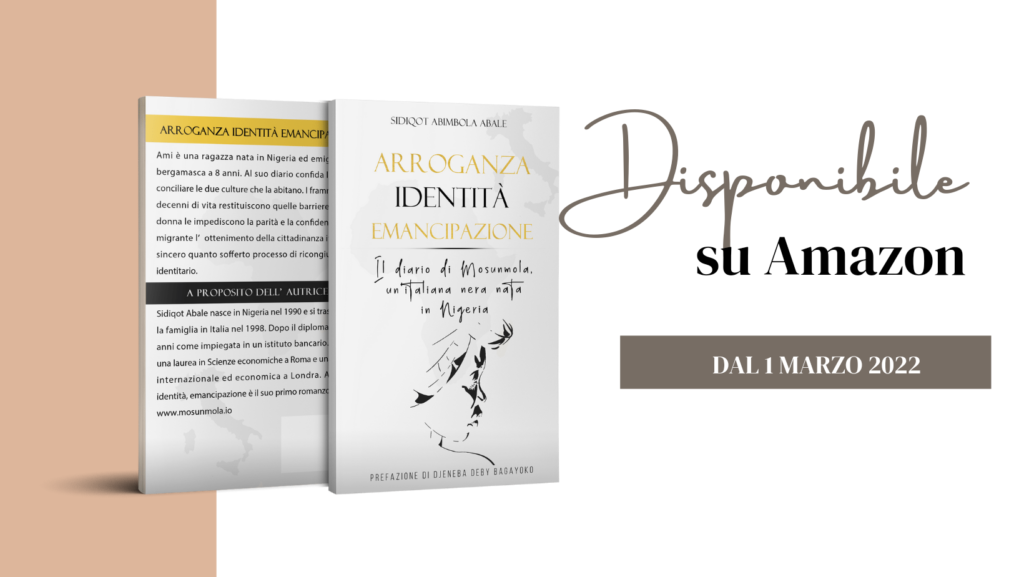
Diario di una donna nera africana Arroganza, identità, emancipazione è il titolo del primo libro scritto da Sidiqot Abimbola Abale. Si tratta di un diario,
This Post Has One Comment
Wow! What an offering. Thank you. Sincerely. I am.